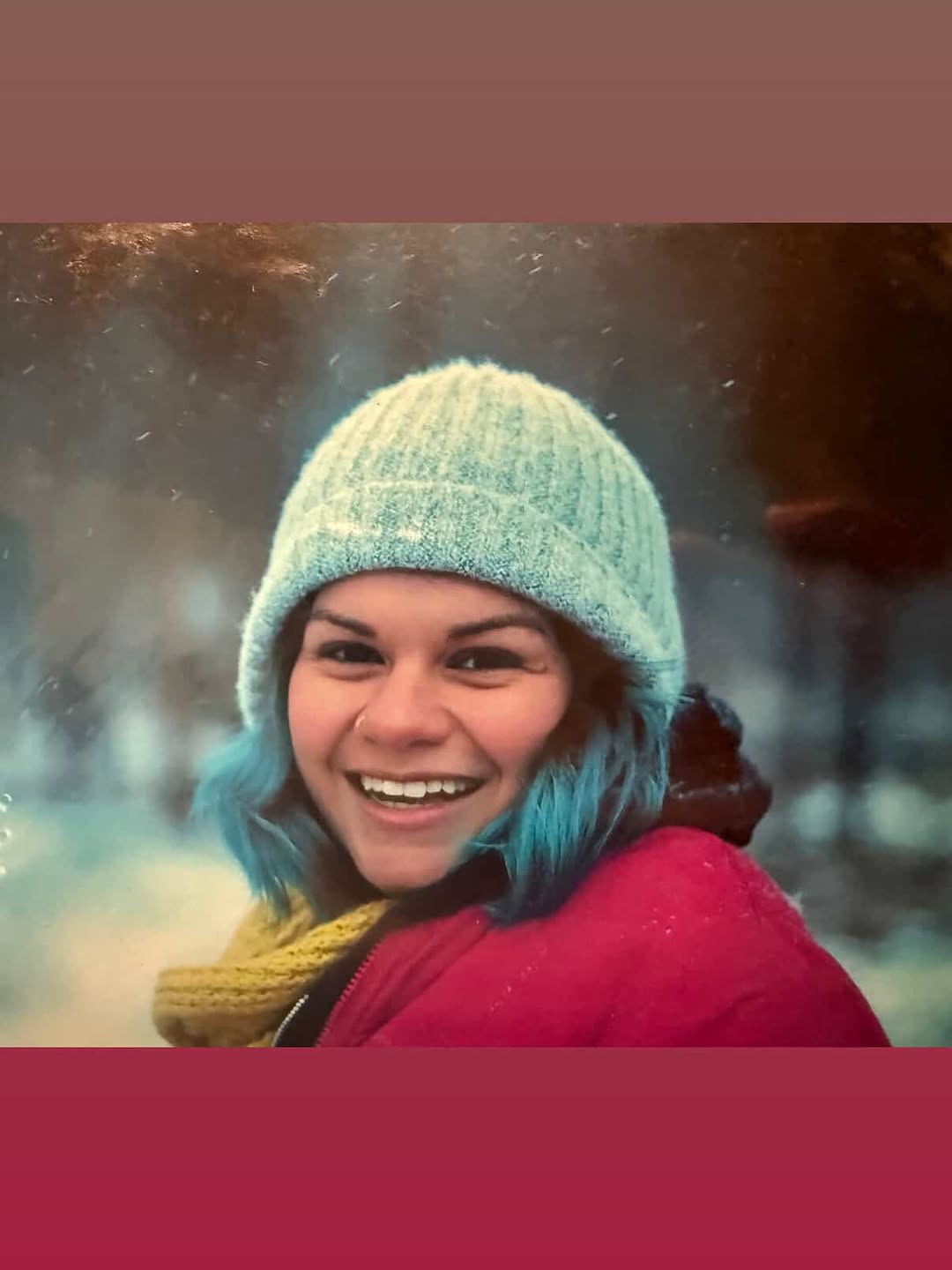
On July 4th, during a protest at the Prairieland Detention Center in Alvarado, Tx Maricela Rueda was arrested for speaking out against the injustices of the immigrant detention system. She is currently incarcerated for taking a courageous stand in defense of dignity and justice. Maricela has always been a tireless advocate for human rights. Maricela is a mother, a daughter, a sister, and a loyal friend. Her arrest has left her family facing sudden and overwhelming challenges. Maricela’s young daughter is now without her mother’s daily love and care, and her family must also manage her estate and responsibilities while navigating the uncertainty ahead. We are asking for your support to help ease the financial strain during this heartbreaking time. All funds will go directly toward caring for her daughter and managing the urgent needs of her household. Thank you for standing in solidarity with Maricela and those who love her.
We’ve finished the latest version of the NYC ABC “Illustrated Guide to Political Prisoners and Prisoners of War” and it’s available for viewing (and download) by clicking on the link below.
This update includes updated mini-bios, illustrations, and address changes for several prisoners. Unfortunately, this edition adds four of the non-cooperating Prairieland defendants–Rowan Gibson, Autumn Hill, Mari Rueda, and Champagne Song.
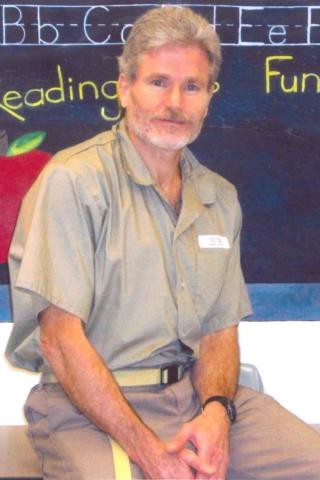
The agency of repression closed the yard for my contribution to RDTW, this weekend before the fall, 2026. The passage of time is revealing a rift between the concrete paving the small courtyards that remained open and the knees. The hamstrings and the ridiculously curved treadmills have a similar schism. So I rode an elliptical into the fray to Run Down the Walls. I let ’em have both legs three days and then again two days before the fall, 19 & 20 September. I had to do some slithering to access the venue the second day, but so it goes in life with big brother And the day before the fall, I write this report. Plus, I may have added one more means of motion to run down the walls: rowing. After my engagements on the ellipticals had ended, I wrestled the rowing machine to wring a few more gritty grains from the walls.
As my feet pushed ever forward and my arms aided and abetted, the elliptical didn’t carry me any where but figuratively. My forced presence in that physical moment, however, let me, made me, invited me me to notice the little drops of sweat hitting the concrete floor as they dripped off me. At first, just a few isolated individuals dotted the scuzzy gym floor–literal drops in the bucket, but without even a bucket. But the drops started coming in numbers, and their dots started running into each other. They started making bigger splats together than by themselves. They started to run together into a puddle. Not much of a puddle, but a puddle. Tiny ripples started to appear–and what is a ripple but a baby wave? Making waves in a social order like ours is always good. Some drops hitting the nascent puddle launched diminutive splashes, maybe reaching as far as the wall, where some of them eroded and ran off with some molecules of wall. Best of all, drops and splats and small ripples from the guy sweating on the next machine started running together with mine. Don’t know where he came from. Don’t know what car he rode in. But he was throwing down some work for a better future like I was. And our collective drops of sweat were conquering the entire floor.
May your Fall be a season of of connection, progress, and feeling good!
The future holds promise!
Bill Dunne 21 September 2026
Bill Dunne #10916 086 FCI Butner Medium II Post Office Box 1500 Butner, North Carolina 27509
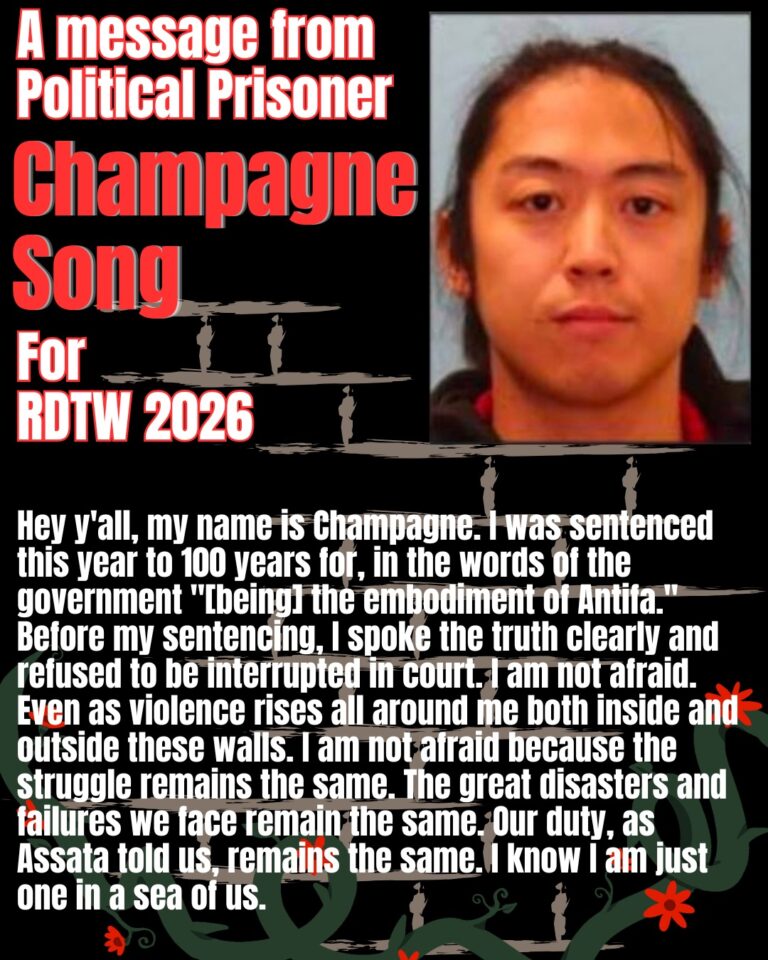
Hey y’all, my name is Champagne. I was sentenced this year to 100 years for, in the words of the government “[being] the embodiment of Antifa.” Before my sentencing, I spoke the truth clearly and refused to be interrupted in court. I am not afraid. Even as violence rises all around me both inside and outside these walls. I am not afraid because the struggle remains the same. The great disasters and failures we face remain the same.
Our duty, as Assata told us, remains the same. I know I am just one in a sea of us. We are strong. We are smart and capable. We are committed. We will think and love and win. We will care for and protect each other. We will speak and listen, connect and grow. The better world we struggle for is our duty and our birthright. I will continue to fight for it. We will win it together. Thank you, each and every one of you. I am so grateful for the work and support of the ABCF and events like RDTW. Thank you for supporting us, supporting this, supporting yourself. I will see you when we are all free!
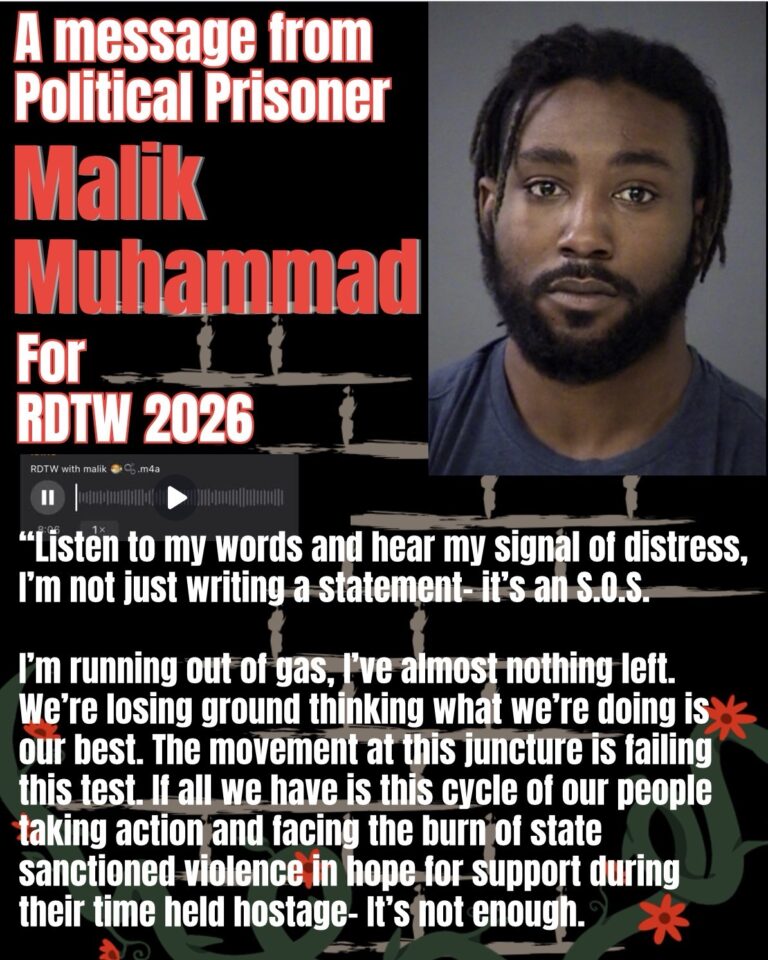
Listen to my words and hear my signal of distress. I’m not just writing a statement. It’s an SOS. I’m running out of gas. I’ve almost nothing left. We’re losing ground thinking what we’re doing is our best. The movement at this juncture is failing this test.
If all we have is this cycle of our people taking action, then facing the brunt of state-sanctioned violence and hope for support during their time held hostage, it’s not enough. If we can muster money for lawyers to negotiate our surrender and get them rich, these agents of the state, this is no better. If paying the state millions for our people to survive inside and communicate with loved ones is our best, our imagination is stunted. We cannot limit ourselves to the confines of the box the state has given us. We cannot work with the ones causing the problem, No! We must do more, do better.
Reaching into hell and pulling those the state has damned from the depths. This is no easy task, tattered, torn, burnt, and charred, one might get, but to break chains of bondage and defy those who would call themselves authorities of us and hold demean over us, it is worth it. To tell the state, No! you cannot have that one. You may not hold freedom’s son, daughter, brother, father, mother, wife, sister, none. None you may keep. For those you steal away, freedom we’ll pursue, to the depths of hell.
And this is hell. Each day we burn, licked by the roaring flames of the state, entombed in this concrete belly of the beast. Every day is a feat to survive. Every action the state takes against us is violence. These $6 phone calls, that should be $3, but because GTL is allowed to rape our families’ pockets, taxing $3 just to double that, that’s violence. The hell we endure goes beyond monetary exploitation, and it doesn’t matter what state you’re in. Under Nikki Haley’s stewardship, South Carolina only gives two meals on the weekends, brunch and dinner. The current Trump-backed candidate says “pack them four to a room and feed them roadkill”. A very moderate stance when you consider these penal colony death camps and what we endure, a slow genocide. It matters none where you are. Some have the audacity to say the federal prison is better or this state is worse. No. Hell is hell. A plantation is a plantation. Because bondage and slavery is bondage and slavery. Whether your plantation is akin to Toni Morrison’s sweet home depiction, or the antebellum super planters, or the ones that forced us to build railroads and trains bites and bridles in our mouths with the tacit threat of lynching for fun, or being strung up head over a fire to boil our brains – plantations are plantations as a death camp differed from a work camp only in how prolonged your death may be, your end is the same.
It doesn’t matter if you’re a political prisoner, politicized prisoner, or a victim of state-sanctioned poverty and circumstances that forced you into acts of survival they criminalized to ensure your demise. It’s a death march, a slow genocide. The end is the same whether you were shuffled into the gas chambers or the ones picking the bodies clean as bid by your captors. Choctaw, Cherokee, Navajo, or Apache, the state, violence, genocide, and subsequent seclusion on reservations by way of colonization in hopes you’d wither and die and disappear into the collective memory black hole of this fascist state is the same end. Prison, detention centers, reservations, work camps, death camps, plantations – all genocide. There’s no difference.
And if you recognize these as such and believe support is our best, then you do not overstand what we’re talking about. You listen, but don’t hear. You care, but don’t feel it. Being here to help isn’t the need, but recognizing this shit is killing you too, and fighting, is. Four people died in SCDC last week. One suicide, one heart attack, two other cancers. This menial food is poison. The conditions, hell. From here to Oregon, to Cali, Washington, New York, Illinois, these straights are dire, and we need action.
You will not be able to run down these walls without a tank, and noise demos aren’t explosive enough alone to open these cages. We can’t let this be the end for us. This cycle of action, criminalization, kidnapping, ransoming, negotiated surrender, and held hostage in the belly of the beast for decades in hopes for release. Abibifahodie means African liberation. Yohuru Sasa means freedom now. Not yesterday. Not in a decade. Sio. No. Sasa. Assata said “it’s our duty to fight and our duty to win””. Ushindi. Victory is the only outcome. But we won’t achieve Ushindi through the state’s allotted means. Only by burning and scorching our hands, digging deep into the pits of the earth, risking life, and limb can we pull out those the state tries to claim. Imagine the actions if our people knew that should they be caught and captured, this is not the end. Imagine if they knew they could evade capture and continue their action because the people got them.
The Underground Railroad smuggled people out of hell to what they thought was freedom, but only a different place than hell. Out of the frying pan and into the fire, but reverse. The Haitians had no illusion of a free north, their only recourse was liberation or death by any means. And that’s our state of being. Liberation or death. Not just for us in these pits licked by flames, but for you in the frying pan, who can be cast into the fire for anything, given the proclivities of the state. There is no free North, no freedom here in America, no innocence either. Everyone is a part of the problem, and everyone can be a solution too.
The map was plotted by our ancestors before. We know what to do. These are plantations, and those who liberated us from plantations in the past were criminalized and demonized. We shouldn’t shirk that, because either you’re an activist or a criminal. Doing the hard things, the things that need done will elicit labels and brandings. The state will call you everything They are. Terrorists, violent, rioter, criminal, but nothing that you truly are. Revolutionary, radical, liberator, or the people. This is because history can only be understood backwards. What is a criminal act today will be resistance in time. What is terrorism today will be liberatory in time. An act of treason today will be revolution in time.
Hear my words. Feel my meaning in pain. This is an SOS. I’ll call to do more. Do better in your best. Do the hard things. Think outside the confines of what caused the problem. Do better than our best. I want to be free. I want to see us all free. I don’t want to write letters and support for decades those I love who, out of love, risked it all. I want to reach into hell and raise those souls out of bondages and flames and never let the state lay claim to another one of us.
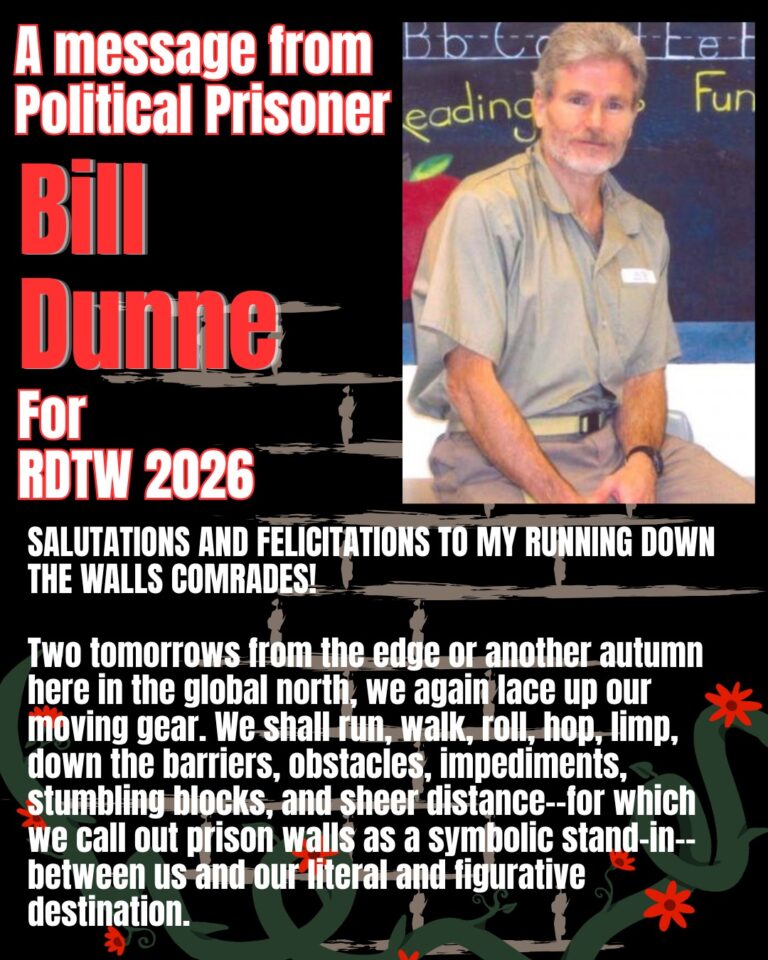
SALUTATIONS AND FELICITATIONS TO MY RUNNING DOWN THE WALLS COMRADES!
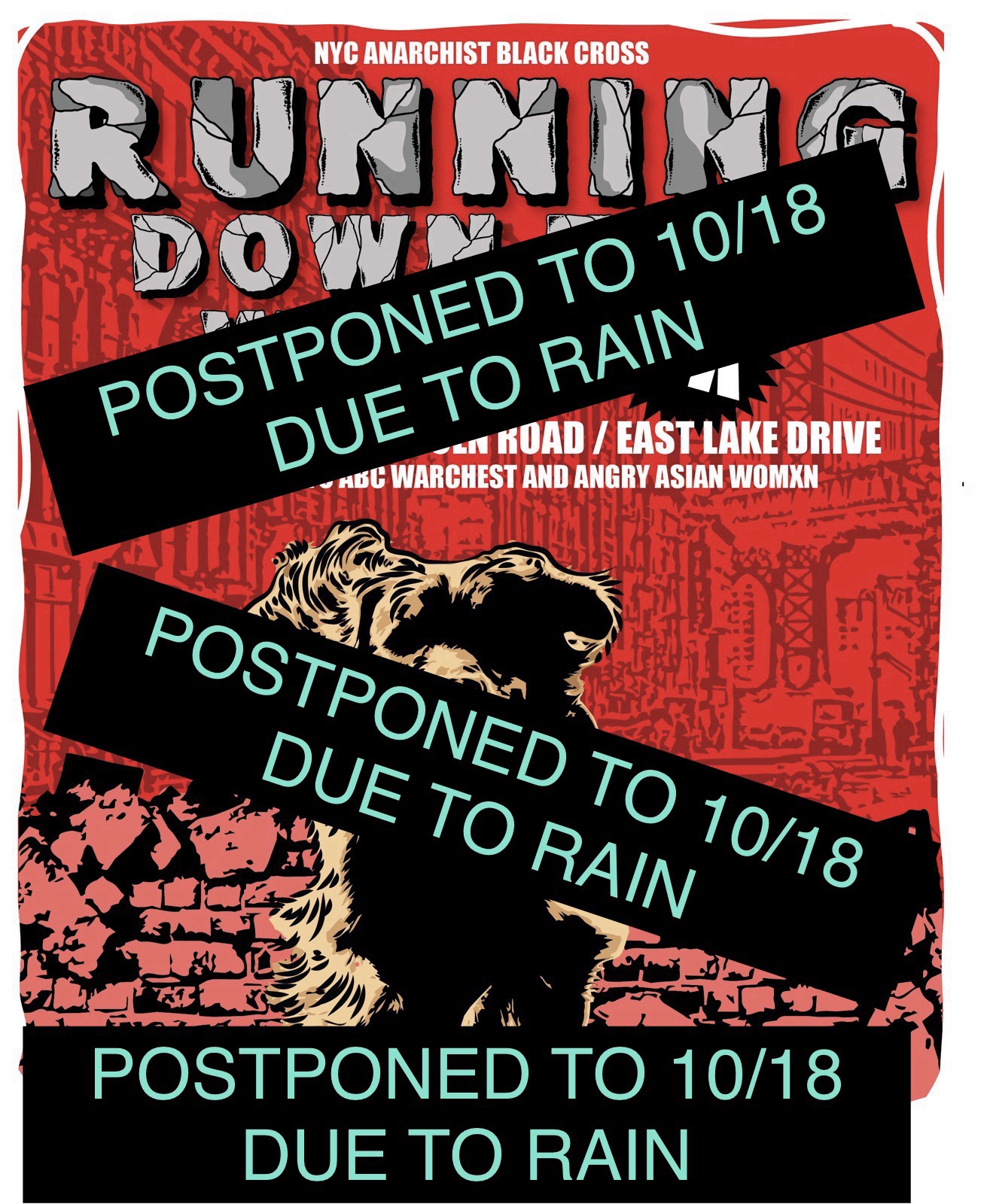
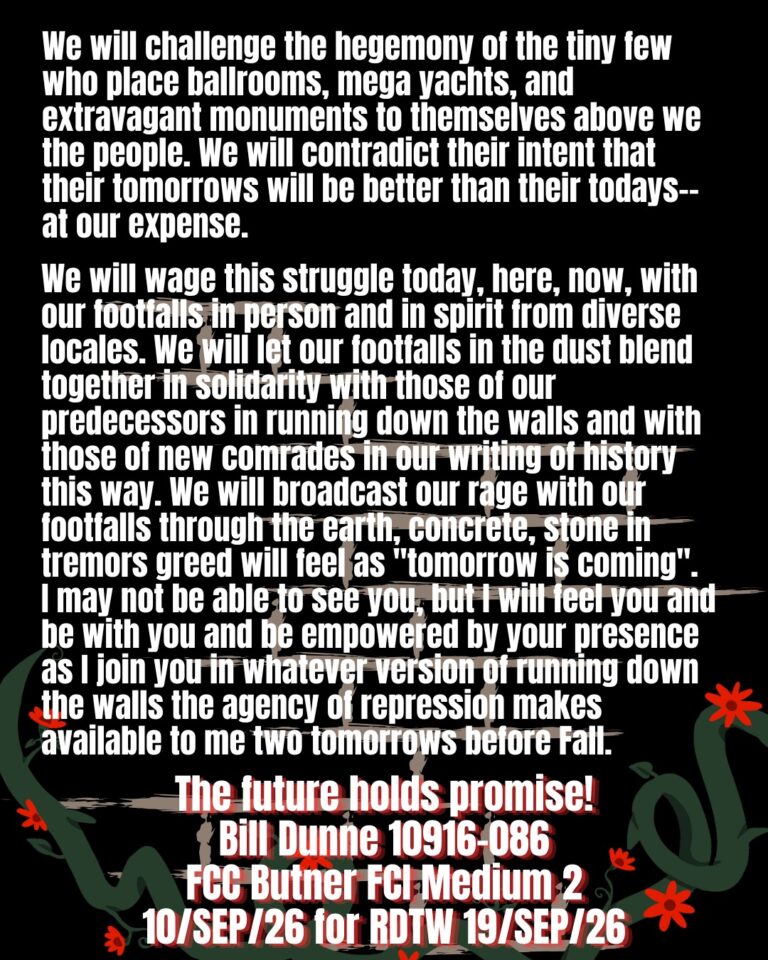
Two tomorrows from the edge or another autumn here in the global north, we again lace up our moving gear. We shall run, walk, roll, hop, limp, down the barriers, obstacles, impediments, stumbling blocks, and sheer distance–for which we call out prison walls as a symbolic stand-in–between us and our literal and figurative destination. We may not reach that most equitable social reality in which all people will have the greatest possible freedom to develop their full human potential today. But we will unite across time and space and identity to make common progress for all the tomorrows that will come as we together run down the walls.
We will confront the apparatus of repression’s houses of steel and concrete and pain behind whose walls greed imprisons and tortures our friends, comrades, neighbors, relatives for the crimes of being here, wanting enough food, medicine, housing, security, education, seeking living wages for meaningful work. We will contest a predatory aristocracy’s imprisonment of our class brethren, sistren, nonconren within artificial national borders where that elite can more readily redistribute wealth upward and commit genocide against resisters’ communities. We will challenge the hegemony of the tiny few who place ballrooms, mega yachts, and extravagant monuments to themselves above we the people. We will contradict their intent that their tomorrows will be better than their todays–at our expense.
We will wage this struggle today, here, now, with our footfalls in person and in spirit from diverse locales. We will let our footfalls in the dust blend together in solidarity with those of our predecessors in running down the walls and with those of new comrades in our writing of history this way. We will broadcast our rage with our footfalls through the earth, concrete, stone in tremors greed will feel as “tomorrow is coming”.
I may not be able to see you, but I will feel you and be with you and be empowered by your presence as I join you in whatever version of running down the walls the agency of repression makes available to me two tomorrows before Fall.
The future holds promise! Bill Dunne 10916-086 FCC Butner FCI Medium 2
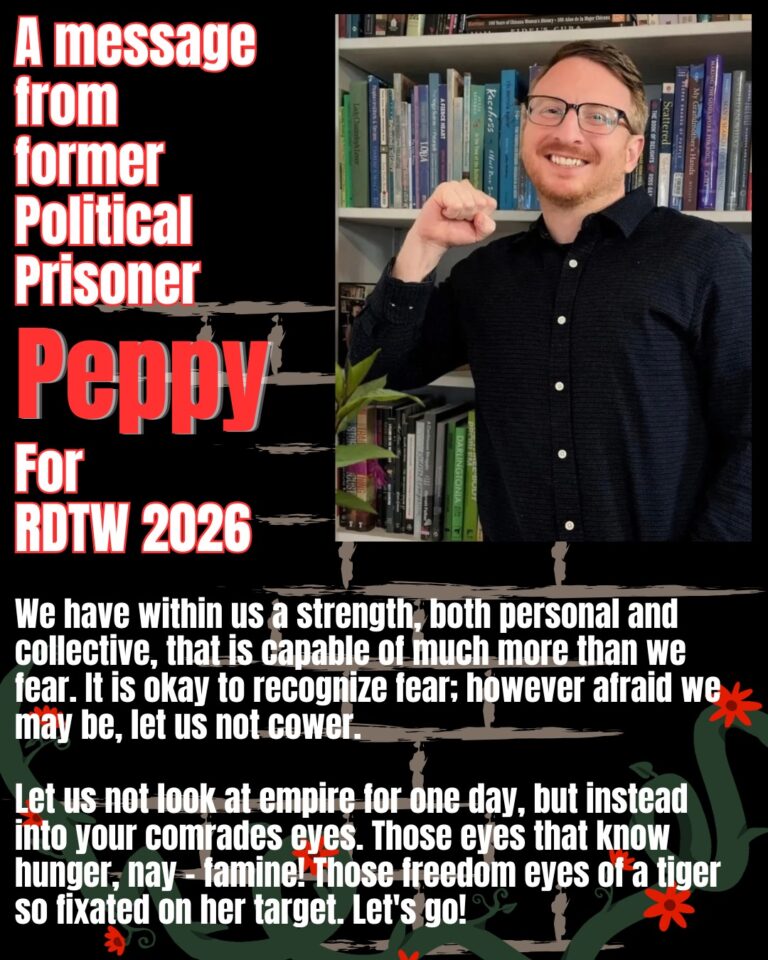
We have within us a strength, both personal and collective, that is capable of much more than we fear. It is okay to recognize fear; however afraid we may be, let us not cower.
Let us not look at empire for one day, but instead into your comrades eyes. Those eyes that know hunger, nay – famine! Those freedom eyes of a tiger so fixated on her target. Let’s go!
This year in celebration I join my partner Krystal and fellow veterans Marius Mason, Jessica Reznicek, Nikos Maziotis on the streets for the first time in many moons. We lick our paws from the wounds we have been dealt and we continue to proclaim the struggle for liberation.
We continue to act for freedom. We continue to run down the walls. We continue to remember our fallen.
May you feel as I have felt the whole period of incarceration — a thousand hands at my back and the ancestors in front of me who laid the path and broke trail with their efforts.
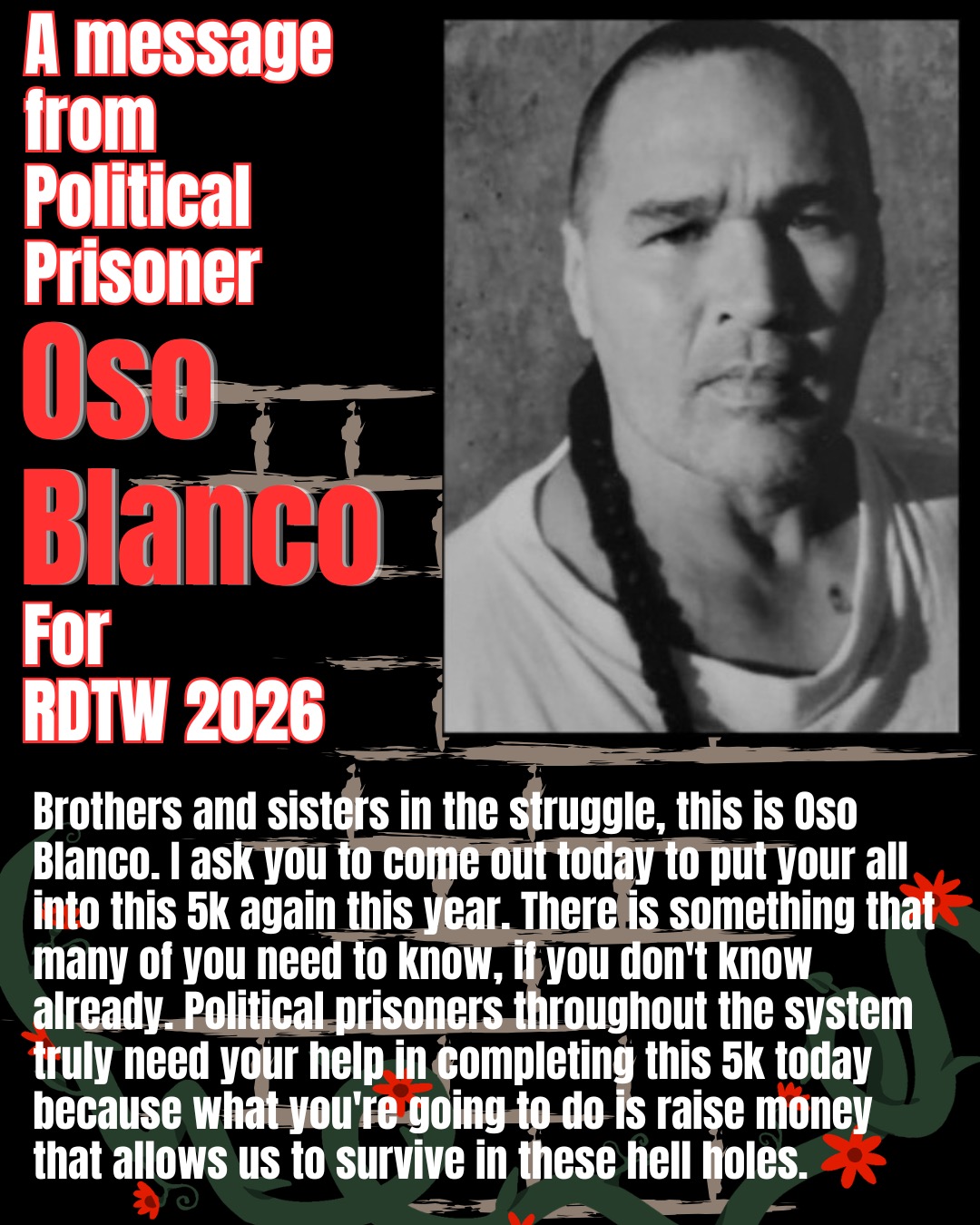
Brothers and sisters in the struggle, this is Oso Blanco. I ask you to come out today to put your all into this 5k again this year. There is something that many of you need to know, if you don’t know already. Political prisoners throughout the system truly need your help in completing this 5k today because what you’re going to do is raise money that allows us to survive in these hell holes. It has become increasingly difficult to live in here — just to buy soap, toothpaste, and basic essentials has become prohibitively expensive and makes it difficult to survive in state and federal prisons and jails. Needless to say this is because this is a money making scheme; it’s all about profit, not justice in this industrial prison complex. I ask you to put forth your best effort today. You may feel tired, like giving up, but remember that we need you and we need your help in getting us out of these horrible places. I love you all. Oso Blanco https://freeosoblanco.org
Write Ron and show him some support: Ronald Reed #219531 Minnesota Correctional Facility – Lino Lakes PO Box 247 Phoenix, MD 21131
Board again denies parole for man convicted in 1970 murder of officer James Sackett Sr.
Minnesota’s Supervised Release Board has again denied parole to a man convicted in the ambush murder of St. Paul Police Officer James Sackett Sr. The board’s meeting on Friday marked the fourth time that Ronald Reed, 76, appealed for his release.
Julie Sackett was 14 months old on May 22, 1970 when a sniper’s bullet killed her father. She was too young to remember him.
“All I have is photos,” Sackett said in a phone interview with MPR News on Friday.
Officer Sackett had responded to an emergency call about a pregnant woman in distress at Hague Avenue and Victoria Street, about a half mile from the governor’s residence, but there was no emergency.
Investigators said that Ronald Reed had lain in wait with a .30-caliber rifle and fired at Sackett from across the street. Prosecutors said that Reed, who is Black, wanted to impress the national leadership of the Black Panthers by killing a white police officer.
The case sat dormant for decades until reporting by KSTP-TV led investigators to reopen it. In 2006, a Ramsey County jury convicted Reed of first-degree murder and conspiracy.
A judge sentenced Reed to life in prison, but because he was tried under the law in place at the time of the killing, Reed became eligible for parole after serving less than 17 years.
The Sackett family did not have the opportunity to testify at the Friday hearing. But Julie Sackett said that each time Reed is up for parole, they and hundreds of their law enforcement allies write letters to urge the board to keep him incarcerated.
“I don’t think that it’s fair that anyone that murders somebody should ever be released from prison, let alone a police officer,” Sackett said. “In this case, he murdered a police officer by ambush, lured them to the scene of the crime, and shot them on purpose.”
With one of the five members absent, the board deadlocked 2-2 on Corrections Commissioner Paul Schnell’s motion to deny Reed parole. Under the board’s rules, Schnell broke the tie.
Speaking by video link from the Lino Lakes prison, Reed called the move political; Schnell said the Sackett family’s wishes drove his decision.
“Can you tell me why you’re taking this hard-line position?” Reed asked.
“I think I made it clear my position, and it was victim and public sentiment,” Schnell replied.
Ronald Reed appears before a meeting in St. Paul of Minnesota’s Supervised Release Board by video link from the Lino Lakes prison.Screenshot via video
While Julie Sackett, her mother, siblings and other family members watched the hearing by video, many of Reed’s supporters appeared in person.
Melvin Carter II, a retired St. Paul police officer and father of former Mayor Melvin Carter III, was among them. The elder Carter is a rare voice in the law enforcement community calling for Reed’s freedom.
One of the department’s first Black officers, Carter joined the force several years after the murder. He’s known Reed since grade school. After Friday’s hearing, Carter said that his friend is no threat to public safety and has changed for the better.
“When that crime happened, he was 19 years old,” Carter said. “It’s time to let him go. In terms of being a burden on taxpayers, how much does it cost to keep a person in prison now? We’re just keeping him in there because we gotcha. And that’s what the system has done to Black people forever.”
Carter also questions whether Reed got a fair trial; Reed maintains his innocence.
The Minnesota Supreme Court reversed the murder conviction of Reed’s co-defendant Larry Clark in 2008. Clark later reached a plea deal with prosecutors on a less serious charge and was released.
Sackett said that her large extended family, which now includes many nieces, nephews, and grandchildren, will never let her father’s legacy fade.
“My father was a kind man, a loving man. He loved the community, and that’s why he responded to this phone call. He responded to this call to help a woman in distress. And what did he get, and what did we get? A life sentence,” Sackett said.
Reed’s next chance to petition for his release is in early 2028. Sackett said that she and her family will keep fighting to keep him in prison.